Whether fire department, ambulance service, police or armed forces: a device that works flawlessly in the office quickly reaches its limits in frontline service. The industry page Public Safety puts it in a nutshell: "For police/fire/rescue, reliability matters more than any feature list." The industry page Military puts it in similar terms: "In a military environment, ruggedness, standardization and policies are what matter." This article describes seven concrete requirements that arise from these operating conditions - from operation with gloves, to legibility in sunlight and darkness, vehicle operation, the hot-swap battery for shift work, mobile network and location tracking, right through to access protection and what happens to the data if a device is lost.
What First Responders Expect From Their Devices
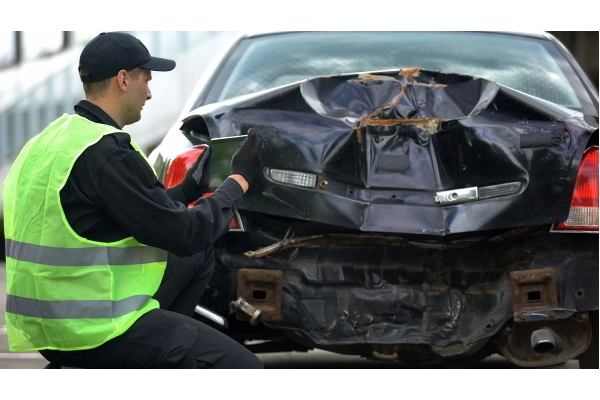
Both industry pages name the same core points for ruggedness and equipment: "Rugged to MIL-STD-810G and IP64+", "dust-tight and water-jet protected", "light with long battery life", and "Windows 11 preinstalled". For frontline service, according to Public Safety, this is typically joined by "in-vehicle docking, LTE/GPS, rugged devices for weather/impacts and fast handovers", while in the military environment, according to Military, it is "clear protection classes depending on the mission, optional security features (smart card/RFID depending on model), and defined configurations". Both pages name navigation to the incident location, photo documentation of accident scenes or incident locations, and data capture - such as reading health insurance cards via an optional card reader - as typical use cases. The following sections go into the individual device requirements that arise from these operating conditions.
Operation With Gloves
Anyone who wears protective gloves in the field knows the problem: an ordinary capacitive touchscreen detects a finger through its electrical charge - an insulating glove dampens this signal so much that the touch no longer registers. How capacitive and resistive touchscreens work technically, and which devices in the range come with their own glove or rain mode, is explained in detail in the article Touch in Wet Conditions and With Gloves. For the models relevant here, according to the comparison table: the Durabook U11I and the Durabook R8 have a touchscreen mode for gloves, the Durabook Z14I has the touchscreen built in as standard, and the Durabook S14I has it as an option. For first responders switching between bare-handed data entry in the vehicle and gloved operation at the incident location, a device with a switchable mode is generally more practical than one designed for a single scenario only.
Legibility in Sunlight and in the Dark
Both industry pages list a "display legible in sunlight" as an equipment feature, with Military adding that it makes it possible to "read all information on the tablet or laptop clearly and legibly even in direct sunlight". How many nits are needed for this and what role anti-glare treatment plays is explained in the article Sunlight-Readable Displays: Nits, Anti-Glare, Polarizing Filters. Concrete values are on record for the recommendations of both industry pages: the Durabook R11 is optionally available with 1000 nits, as is the Durabook U11I, while the Durabook Z14I comes standard with a sunlight-readable display at 1000 nits. For operation in darkness, keyboard backlighting is also relevant: according to the Laptop Comparison Table, an LED keyboard backlight is standard on the Durabook Z14I, and optional on the Durabook S15 and S14I.
Vehicle Operation
"In-vehicle docking" is one of the typical requirements named on Public Safety - patrol cars, emergency vehicles and ambulances are a regular place of use for these devices. For a device to run reliably in a vehicle, it must withstand the temperatures that occur there: a vehicle standing in the sun in summer can reach interior temperatures well above the outside air, especially on the dashboard, where docking stations are often mounted. The article Operating Temperature: What -20 °C to 60 °C Means in Practice explains why this heat exposure is often more critical than frost. According to the Laptop Comparison Table, the row "operating temperature -20°C to 60°C" is confirmed for the Durabook S15, S14I and Z14I, and likewise according to the Tablet Comparison Table for the tablet models R11L, R11, U11I and R8. For permanent installation in a vehicle, port equipment also matters: for S15, S14I and Z14I, a docking connector is optional for S15 and S14I according to the comparison table, and standard on the Z14I.
Hot-Swap Battery for Shift Changes
In stations and control rooms running continuous shifts, a device must not fail at handover because of a dead battery. How battery swapping works technically during ongoing operation and which models support it is explained in detail in the article Swappable Battery and Hot-Swap: Continuous Operation Without Shutdown. What matters for frontline service: for the Durabook U11I, the equipment list on both Public Safety and Military explicitly names "technology for swapping the battery during ongoing operation (hot-swap battery)" as an optional feature. According to the Laptop Comparison Table, the Durabook S15, S14I and Z14I additionally offer an optional bridge battery with a swap time of around five minutes, which allows the main battery to be swapped without shutting the system down. The Durabook S15AB is different: this model uses a fixed, non-removable battery with a runtime of up to 13 hours, without the option of a battery swap during ongoing operation - a difference that can be decisive when choosing a model for continuous shift operation.
Mobile Network and Location Tracking
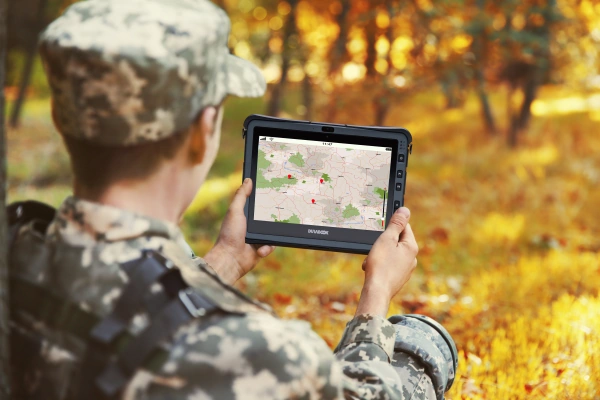
On Military, "mobile internet" is named as its own use case: "With LTE/GPS module for internet reception as well as location tracking/navigation." On Public Safety, "LTE/GPS" is among the typical equipment features for navigation to the incident location. How GPS differs from GNSS, what accuracy an ordinary receiver achieves, and when RTK correction data is needed is explained in the article GPS, GNSS and RTK: Accuracy Classes Explained. For frontline service, the meter-level accuracy of an ordinary GNSS receiver described there is generally sufficient for navigation, tracking of emergency vehicles, or the rough geo-referencing of documentation photos. On the Durabook U11I and the Durabook S14I, dedicated GPS can additionally be combined with 4G LTE or 5G mobile network; on the Durabook R11, however, a GPS-only variant and a combined LTE/GPS variant are mutually exclusive according to the configurator - anyone needing both at once must choose the combo option for this model.
Access Protection via Card or TPM
On Public Safety, "reading health insurance cards via the optional card reader" is named as a concrete use case in data capture, while on Military, "optional security features (smart card/RFID depending on model)" are described as typical for military use. How a smart card reader and a TPM chip work together, and why this combination is often required in government and frontline environments, is explained in detail in the article Smart Card Reader and TPM: Access Protection in the Field. In short: according to the Laptop Comparison Table, TPM 2.0 is present on all four compared laptop models (S15, S14I, Z14I, S15AB) and handles, among other things, drive encryption and protection against firmware tampering. A smart card reader is built in as standard on the Durabook Z14I, and optional on the S15, S14I and S15AB. Further security mechanisms such as SSD encryption to OPAL 2.0, the Kensington lock and NIST BIOS compliance are described in the article Ideal Laptop Protection: 5 Security Features and Protective Mechanisms.
What Happens to the Data if a Device Is Lost?
If a device is lost or stolen in the field, the mechanisms named above work together - explained in detail in the section "What Happens if a Device Is Lost?" of the article Smart Card Reader and TPM. Without the matching smart card and the associated PIN or biometric feature, no one can access the user account, because the possession factor of a chip card, unlike a password, cannot simply be guessed or copied down. The data stored on the drive remains additionally protected by encryption, whose key is bound to the TPM chip - an attacker who physically removes the SSD does not gain access to the key without further effort. For organizations with an official chip card, a lost device in practice mainly means organizational effort: the lost card must be blocked and replaced, while the device itself, thanks to TPM-bound encryption, does not allow access to the stored data without the card.
Ruggedness as a Basic Requirement
All the requirements described so far assume that the device itself can withstand the stresses of frontline service. Both industry pages name "rugged to MIL-STD-810G and IP64+" as the minimum standard for this. Specifically, according to the comparison tables and product data, the Durabook R11 is tested to protection class IP66 and to MIL-STD-810H, and the Durabook U11I to IP65 and MIL-STD-810G. For the laptops, the Laptop Comparison Table lists a drop protection of up to 180 cm for the Durabook Z14I along with protection class IP65 and testing to MIL-STD-810H and MIL-STD-461G, for the Durabook S15 and S14I drop protection of up to 120 cm at IP5X and IP53 respectively along with MIL-STD-810H, and for the Durabook S15AB drop protection of up to 90 cm at IP5X and MIL-STD-810G. A detailed explanation of the IP protection classes is provided by the article IP57 and the Other IP Protection Classes in Detail.
Which Devices Are Suitable for Frontline Service?
The two industry pages Public Safety and Military each contain their own recommendations with full technical data. For tablets, they name, among others, the Durabook R11 with an 11.6-inch Full HD touchscreen, IP66 and MIL-STD-810H, and the Durabook U11I with optional LTE/GPS, hot-swap battery and sunlight-readable display; Military additionally names the Durabook Z14I with a 14-inch touchscreen, IP65 and an optional hot-swap battery. Which model fits a specific mission depends on the combination of display size, ports, battery concept and access protection. A complete comparison of all technical data is provided by the Laptop Comparison Table and the Tablet Comparison Table.
Frequently Asked Questions
Is an ordinary touchscreen enough for use with gloves?
An ordinary capacitive touchscreen without its own mode generally does not reliably detect a glove. Devices such as the Durabook U11I or the Durabook R8 come with their own touchscreen mode for gloves according to the Tablet Comparison Table, as described in the article Touch in Wet Conditions and With Gloves.
What display brightness makes sense for frontline service?
As a reference value for a sunlight-readable display, 1000 nits is consistently named on the Public Safety and Military industry pages, as documented for example on the Durabook R11, Durabook U11I and, as standard, on the Durabook Z14I. Details are provided by the article Sunlight-Readable Displays.
Which device is suitable for continuous operation across shift changes?
Models with an optional bridge battery and hot-swap function, such as the Durabook S15, S14I, Z14I and U11I, can be swapped during ongoing operation - see Swappable Battery and Hot-Swap. The Durabook S15AB, with its fixed, non-removable battery, is not designed for a battery swap during ongoing operation.
What happens to the data if a service tablet is lost?
If the device is configured with smart card login and TPM-bound drive encryption, access to the stored data remains blocked without the matching chip card. Details are provided by the article Smart Card Reader and TPM.
What First Responders Need From Their Device
Devices for first responders must deliver more than an office notebook: they must be operable with gloves, stay legible in sunlight and in the dark, work reliably in a vehicle at high temperatures, allow a battery swap during shift changes without a system stop, enable location tracking and data access via mobile network and GPS, and secure access via smart card or TPM - so that the stored data remains protected even if the device is lost. The industry pages Public Safety and Military bring together the recommended models with full technical data, while the linked articles explain the individual requirements in detail.
If you have questions about the right device setup for your field of operation, the RobustBook team is happy to help you choose the right model.