What a sunlight-readable display actually is and what the unit "nit" means is explained in the introductory article Sunlight Readable Displays. This article builds on that and answers the questions that matter when actually choosing a device: how much brightness do you really need for which location? Why isn't a high nit figure enough on its own if the display isn't anti-glare treated? What role do polarizing filters and optical bonding play in addition to raw brightness? And what does extra brightness cost in battery life? All brightness figures in this article come from the comparison tables, product pages, and industry pages on RobustBook.
How much brightness does a display need – and for what?
Display brightness is not a value you simply maximize. How many nits a screen needs depends on where and how it is used. According to the introductory article Sunlight Readable Displays, conventional office monitors and standard laptop displays sit at a brightness of 250 to 450 nits – enough for indoor spaces with normal or dimmed lighting, but not for direct sunlight.
Within the RobustBook range there is a clear gradation depending on how heavily a device is actually used outdoors:
- 500 nits: The 11.6-inch tablet configuration listed on the industry pages Logistics and Transport optionally comes with a sunlight-readable display at 500 nits – a value suited to situations that alternate between indoor and outdoor work, such as loading and unloading or brief outdoor stints between warehouse and yard tasks.
- 700 nits: The Fieldbook P80 is fitted with a display brightness of 700 nits – combined with an anti-reflective treatment, more on that below.
- 1000 nits: The most common value across the range. It appears as an optional or standard DynaVue display on several Durabook laptops and tablets and is cited on numerous industry pages – for example Construction, Outdoor, Military, and Public Safety – as the reference figure for a "sunlight-readable display".
- 1000–1200 nits: On the industry page Workshop, the optional bright-display range is given as 1000 to 1200 nits – the upper end of what is currently available in terms of display brightness across the range.
The rule of thumb from these figures: anyone who mostly uses a device indoors or in the shade is well served by standard brightness. Anyone who works outdoors regularly but not continuously is well served by a display in the 500 to 700 nit range. Anyone who has to work all day in direct sunlight – on a construction site, in field service, in agriculture – should choose a display with 1000 nits or more.
What nit values the individual devices in the range offer
A complete overview with all technical data is provided by the Laptop Comparison Table and the Tablet Comparison Table. The values listed there at a glance:
- The Durabook S15 is optionally available with a sunlight-readable display of up to 400 to 500 nits.
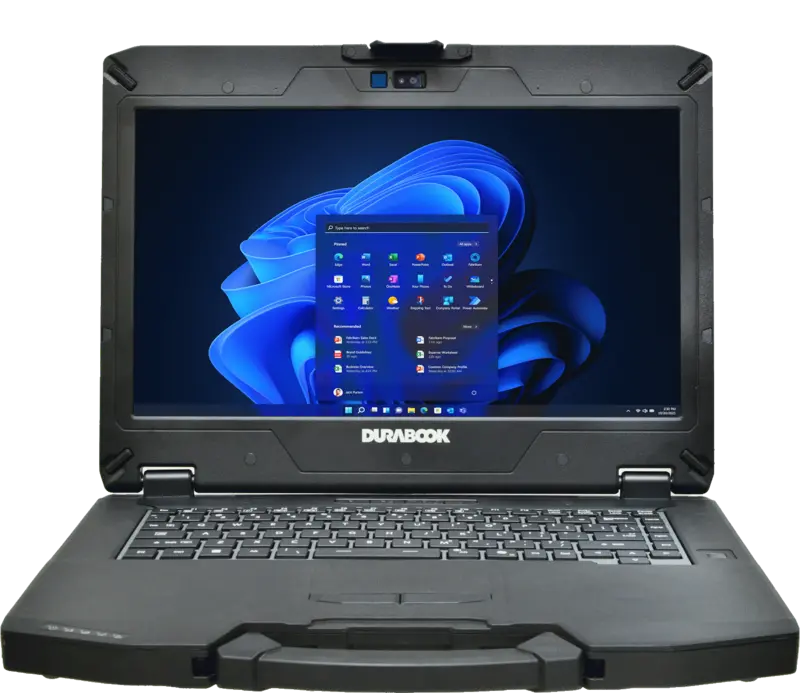
- The Durabook S14I optionally offers the DynaVue display, rated at 1000 nits according to the comparison table.
- The Durabook Z14I comes standard with a sunlight-readable display at 1000 nits.
- Among the Durabook tablets, the sunlight-readable display is optional on the R11L, R11, and U11I models according to the Tablet Comparison Table, while it is standard on the R8 and R10 models – specific nit values for the tablet line are not listed there.
- The Fieldbook P80 has a display brightness of 700 nits, combined with hardened industrial glass and an anti-reflective treatment.
When choosing, it is worth checking the relevant product page, since display brightness is usually listed there as an optional configuration rather than fixed standard equipment – with the exception of the Durabook Z14I, where the sunlight-readable display is part of the standard equipment.
Why brightness alone is not enough: the role of anti-glare treatment
A high nit value on its own only solves part of the problem. Sunlight that falls directly onto a display is reflected off the glossy glass or plastic surface – and this reflection overlays the actual image content like a mirror. The smoother and glossier the surface, the stronger this effect, regardless of how many nits the backlight delivers.
An anti-reflective treatment addresses exactly this: it changes the surface structure or coating of the display so that incoming light is scattered rather than reflected directly. This means no sharp mirror image of the sun or a light source forms on the screen, but rather a diffuse, much weaker brightening of the surface. The Fieldbook P80 combines this approach directly with high display brightness: according to the product page, it has an 8-inch IPS display at 700 nits, protected by hardened industrial glass and additionally fitted with an anti-reflective treatment. The Fieldbook models N101 and N80 G2 also list heat-tempered or hardened industrial glass as display protection on their respective product pages.
The effect of brightness and anti-glare treatment is therefore complementary: brightness increases the absolute luminance of the displayed content, while anti-glare treatment reduces the amount of disruptive reflected light overlaid on that content. Together, the two measures produce noticeably better readability than either one alone.
Why a bright screen without anti-glare treatment is still hard to read outdoors
The reason lies in the contrast ratio, not in absolute brightness. A display creates contrast by emitting more light at some pixels than at others. Reflected sunlight, however, lies evenly across the entire screen surface and therefore lifts the dark image areas just as much as the bright ones – the difference between the two shrinks, and contrast drops. On an untreated, glossy display, strong reflection from direct sunlight can amplify this effect so much that even a display with a high nit count becomes unreadable in places, as soon as the viewing angle coincides with the reflection angle of the light source.
A high nit figure alone is therefore not sufficient as a purchasing criterion for continuous outdoor use. A display with lower brightness but effective anti-glare treatment can be more readable under certain lighting angles than a much brighter but untreated display. In practice, the devices in the RobustBook range designed for continuous outdoor use therefore combine both properties – high brightness and a corresponding surface treatment or hardened, anti-glare cover glass – rather than relying on the nit figure alone.
Polarizing filters and optical bonding: two further building blocks of display technology
Besides brightness and anti-reflective coating, there are two further approaches in display technology that can further improve readability in sunlight. A circular polarizing filter lets through only light with a certain plane of vibration and blocks part of the diffusely scattered ambient light before it reaches the actual display surface – this makes the image appear more contrasty, but at the cost of some display brightness, since part of the usable light is also held back by the filter. Optical bonding, in turn, refers to bonding the cover glass directly to the display layer, eliminating the air gap that is typically present with simply mounted protective glass. This air gap is an additional interface at which light can be reflected; removing it reduces the number of reflection layers and, with it, the tendency toward glare.
No specific, documented figures are available for these two technologies in the RobustBook range – the preceding paragraphs therefore describe the general principle, not the concrete equipment of any particular model. Anyone wanting to know whether a specific device uses one of these technologies should consult the technical data on the relevant product page or contact sales directly.
What does extra brightness cost in battery life?
A display's backlight is among the most power-hungry components in a mobile device. Increasing brightness generally increases the backlight's power draw – a physical relationship that holds regardless of the device manufacturer. How strongly this affects actual battery life in a given case depends on the rest of the system load, the display technology used, and the settings, and cannot be stated as a general percentage.
The Laptop Comparison Table lists runtimes of 10 to 13 hours for the main batteries of the current Durabook laptops. Anyone who regularly works outdoors at high display brightness and needs the longest possible continuous runtime will find additional options in the same table that address exactly this scenario: an optional second battery with its own runtime of 9 to 10 hours, as well as an optional bridge battery that, according to the comparison table, allows a battery swap during operation within 5 minutes without having to shut the device down. The Durabook S15 likewise offers the option of a bridge battery for an uninterrupted battery swap. For users who run a particularly bright display outdoors continuously, the availability of a swappable battery is therefore often more relevant than the exact number of hours on the spec sheet, because it lets the operating time be extended almost indefinitely, independent of the display's actual power draw.
Display brightness as a selection criterion: the practical takeaway
Choosing a rugged laptop or tablet is therefore worth a three-part assessment rather than a single glance at the nit figure:
- How often and how long is the device actually exposed to direct sunlight? For occasional outdoor use, standard brightness or a configuration around 500 nits may be sufficient, as described on the industry pages Logistics and Transport.
- Is there anti-glare treatment or hardened cover glass in addition to brightness? Without this property, even a display with a high nit count can become unreadable at certain viewing angles, as described in the section on contrast ratio.
- How long must the device last without a charging break? Anyone using a bright display outdoors continuously should check the availability of a swappable or bridge battery, see the corresponding options in the Laptop Comparison Table.
These three criteria supplement the plain nit figure explained in the introductory article Sunlight Readable Displays with the practical factors that determine actual readability at a specific location.
Frequently asked questions
How many nits does a display need for continuous outdoor use?
In the RobustBook range, the reference figure for a sunlight-readable display is 1000 nits, in some cases up to 1200 nits. Figures around 500 to 700 nits are documented for occasional or alternating outdoor use. Which value fits in a given case depends on the actual frequency and duration of direct sunlight exposure.
Is a high nit count alone enough for good readability outdoors?
Not reliably. Without anti-glare treatment, reflected sunlight can reduce contrast so much that even a very bright display becomes hard to read at certain viewing angles. What matters is the combination of brightness and a treatment that reduces reflections.
Which RobustBook devices have a standard sunlight-readable display?
According to the comparison tables, the sunlight-readable display is standard on the Durabook Z14I as well as on the Durabook R8 and R10 tablets. On the other models it is available as an option.
Does a brighter display noticeably shorten battery life?
Higher display brightness generally increases the backlight's power draw. A single percentage figure valid for all devices cannot be given. Anyone who needs a long, continuous runtime despite high brightness can turn to an optional second battery or a bridge battery for a swap during operation on several Durabook laptops.
What Makes a Display Sunlight-Readable
A sunlight-readable display results from the interplay of several properties, not from a single figure. Display brightness in nits determines how much light the screen can actively produce; across the RobustBook range it runs from 500 nits for occasional outdoor use up to 1000 or 1200 nits for continuous use in direct sunlight. An anti-reflective treatment and hardened cover glass – as documented for the Fieldbook P80 – additionally reduce the amount of disruptive reflected light and thereby improve contrast, independent of raw brightness. Polarizing filters and optical bonding are two further approaches generally known in display technology, though no specific figures are documented for the current RobustBook range. Anyone choosing a device for continuous outdoor use should therefore look beyond the nit figure to anti-glare treatment and, for intensive use, the availability of a swappable battery. A complete overview of all values is provided by the Laptop Comparison Table and the Tablet Comparison Table.
If you have questions about the right display brightness for your specific use case, the RobustBook team is happy to help you choose the right model.