IP57 is one of the most frequently searched IP protection classes – and is often confused with other classes such as IP65 or IP53. This article explains what the IP57 rating specifically means, how it differs from the protection classes that RobustBook's rugged devices actually carry, and how the IP classification system is structured overall. It also explains why the choice between IP53, IP57, and IP65 is not simply a ranking, but depends on the actual stress expected in the intended use case.
What Exactly Does IP57 Mean?
The abbreviation IP stands for "International Protection" – in English-speaking regions, the term "Ingress Protection" is also commonly used. The two digits following IP are defined in the standards DIN EN 60529 and ISO 20653 (for road vehicles) and separately indicate the protection against contact/foreign objects (first digit) and the protection against water (second digit).
For IP57, the first digit 5 means: the device is protected against dust in harmful quantities and offers complete protection against contact. The second digit 7 means: the device is protected against temporary immersion in water. A device with IP57 therefore withstands brief immersion, but is not designed for permanent immersion – that would only apply with the higher second digit 8.
How Is the IP Protection Class Structured?
First Digit: Protection Against Contact and Foreign Objects
The first digit describes both protection against contact and protection against solid foreign objects, and ranges from 0 to 6K:
- 0: No protection.
- 1: Protected against large-area contact (e.g., the back of the hand) and against large solid foreign objects with a diameter of 50 mm or more.
- 2: Protected against contact with a finger and against medium-sized foreign objects with a diameter of 12 mm or more.
- 3: Protected against contact with tools and wires of 2.5 mm or more, as well as against correspondingly small foreign objects.
- 4: Protected against contact with tools and wires of 1 mm or more, as well as against granular foreign objects of 1 mm or more.
- 5 (or 5K): Complete protection against contact, protected against dust in harmful quantities (dust-protected).
- 6 (or 6K): Complete protection against contact, complete protection against dust ingress (dust-tight).
Second Digit: Protection Against Water
The second digit describes protection against water and ranges from 0 to 9K:
- 0: No protection.
- 1: Protected against vertically falling drops of water.
- 2: Protected against drops of water falling at an angle (up to 15°).
- 3: Protected against spraying water up to 60° from vertical.
- 4 (or 4K): Protected against splashing water from all directions, with 4K also under increased pressure.
- 5: Protected against water jets (nozzle) from any angle.
- 6 (or 6K): Protected against powerful water jets, with 6K also under increased pressure.
- 7: Protected against temporary immersion – this is the digit that defines IP57.
- 8: Protected against continuous immersion.
- 9 (or 9K): Protected against water from high-pressure/steam-jet cleaning, in agriculture (9) or for road vehicles (9K).
This also shows why IP57 is not automatically "better" than IP65: the second digit 7 (temporary immersion) and the second digit 5 (water jets) test different types of stress, and neither one includes the other. A complete tabular overview of both digits can also be found in the article The Different IP Protection Classes.
IP57 Compared to IP65, IP53, and IP5X
All four classes start with the first digit 5 – that is, complete protection against contact and protection against dust in harmful quantities. The difference lies in the second digit, or in the "X":
- IP5X: The X is a placeholder – no digit for water protection is specified or tested.
- IP53: Protected against spraying water up to 60° from vertical.
- IP57: Protected against temporary immersion in water.
- IP65: Protected against water jets (nozzle) from any angle – a different type of protection than IP57, not necessarily "better," but designed for a different scenario.
Importantly, IP65 and IP57 cannot be directly ranked against each other because they cover different types of stress. IP65 reliably protects against water jets from any angle, for instance when cleaning with a hose. IP57, on the other hand, protects against brief immersion, for instance if a device falls into a puddle – but according to the standard it offers no documented protection against water jets.
In practice, this means: a device with IP65 is not automatically suitable for immersion just because its first digit matches that of IP57. Conversely, a device with IP57 is not necessarily also protected against water jets from every angle. Anyone who wants to cover both types of stress needs a device certified for both tests – usually expressed as two classifications, such as "IP65/IP67."
Which Protection Classes Do RobustBook's Rugged Devices Carry?
Our current Durabook laptops carry the protection classes IP5X, IP53, or IP65 – IP57 is not the assigned class for any current model. Specifically:
- The Durabook S15AB carries the protection class IP5X.
- The Durabook S14I carries the protection class IP53.
- The Durabook Z14I and all RobustBook tablets carry the protection class IP65.
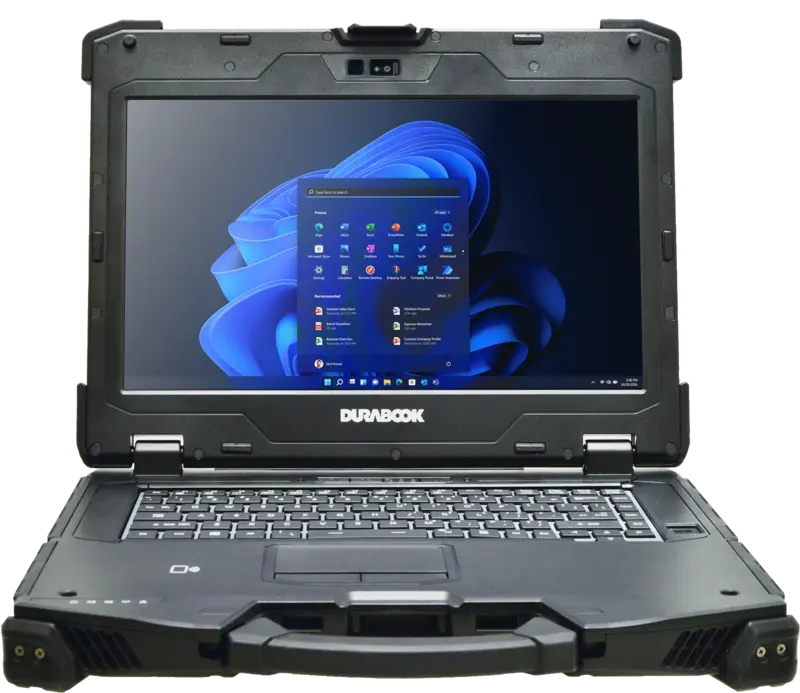
A complete overview of all protection classes by model is provided in the Laptop Comparison Table and the Tablet Comparison Table. Anyone interested in one of these models will find, in addition to the protection class, an overview of further technical specifications such as processor, working memory, and storage on the respective product pages.
Why Do Rugged Laptops Tend to Carry IP5X, IP53, or IP65 Rather Than IP57?
With its protection against water jets from any angle, IP65 covers a scenario that occurs far more often in field use – for example in rain, when hosing down dirty devices, or on the construction site – than brief, complete immersion. IP53, in turn, is sufficient for indoor spaces and light contact with spraying water, for example in the workshop. The choice of protection class is therefore based on the actual usage scenario of the respective model, not on a general ranking of the digits.
Why Is the Label "Waterproof" Not Enough?
Terms such as "waterproof" or "weatherproof" are marketing terms without a defined meaning. They say nothing about whether a device survives a brief rain shower, continuous drizzle, a jet of water, or actual immersion. This is precisely why the IP classification exists: each of the two digits stands for a precisely defined type of stress tested under DIN EN 60529 or ISO 20653. Anyone selecting a device for a specific use should therefore decide based on the specific IP rating, not on vague marketing claims.
IP57 and IP65 at the Same Time – Is That Possible?
A device is tested and certified for a specific combination of first and second digit, not for several combinations at once. A device classified as IP65 is therefore not automatically also tested against temporary immersion (digit 7), even if it might, in practice, withstand that as well. Without a corresponding test and certification, however, this cannot be proven. Anyone who wants to make sure a device is designed for a specific type of stress should rely on the officially assigned protection class – not on a guess about what the device might additionally withstand.
IP Protection Class as a Selection Criterion for Rugged Laptops and Tablets
When choosing a rugged laptop or tablet, it is worth matching the IP protection class to the actual place of use: if the device is used mainly indoors with occasional contact with spraying water, a class such as IP53 may be sufficient. If, on the other hand, the device is used outdoors and must withstand rain or being hosed down, a class such as IP65 is the more suitable choice. For scenarios with a risk of immersion – for example in damp basements, near bodies of water, or during heavy rainfall with pooling water – a class with the second digit 7 or 8 would be relevant, even though none of these is currently assigned to any RobustBook model.
Frequently Asked Questions
Is IP57 Better Than IP65?
Neither – the two classes protect against different types of stress. IP57 protects against temporary immersion, IP65 against water jets from any angle. Which class is "more suitable" depends on the specific usage scenario: for outdoor use in rain or cleaning with a hose, IP65 is more relevant; for situations with a risk of immersion, a class with the second digit 7 or higher would be decisive.
Does RobustBook Have Devices with IP57?
No, the current Durabook laptops and tablets in the RobustBook range carry the protection classes IP5X, IP53, or IP65, see Laptop Comparison Table.
What Does the Digit X Mean in IP Protection Classes?
The X is a placeholder for a digit that has not been tested or specified – for IP5X, this concerns the second digit, i.e., water protection.
Why Do DIN EN 60529 and ISO 20653 Differ?
Both standards define the IP ratings and their test criteria. DIN EN 60529 is the general international standard for electrical equipment, while ISO 20653 is the version specifically tailored to road vehicles. For laptops and tablets in commercial use, DIN EN 60529 is generally the relevant reference.
Can a Device's IP Protection Class Deteriorate During Use?
The IP classification refers to the tested device in its as-new condition. Seals, port covers, and housing parts are subject to mechanical wear; whether and to what extent this affects the actual protective effect over the service life depends, in each individual case, on the condition of the specific device and cannot be stated as a general figure.
How IP57 Differs From IP65 and IP53
In summary, IP57 means: complete dust protection (first digit 5) combined with protection against temporary immersion in water (second digit 7). This clearly distinguishes the class from IP65, which instead covers water jets from any angle, and from IP53, which only protects against spraying water. Which class fits your own use case depends on the stress actually to be expected – not on which digit looks higher on paper. RobustBook's current laptops and tablets carry the classes IP5X, IP53, and IP65; an overview with all technical specifications is provided in the Laptop Comparison Table.
If you have questions about the right protection class for your specific use case, the RobustBook team will be happy to help you choose the right model.