Anyone capturing inventory, shipments, or tools out in the field sooner or later faces the same question: is a barcode scanner enough, or is RFID worth it? Both technologies solve the same basic task – uniquely identifying an object – but in very different ways. This article puts barcode and RFID head to head, explains the difference between HF and UHF RFID, and shows where RFID reaches its limits. Anyone first interested in the basics of RFID and NFC will find them in the article RFID and NFC – this article picks up where the practical decision between barcode and RFID actually arises, and does not repeat the basics covered there.
Barcode and RFID Head to Head
A barcode – whether a classic 1D linear code or a 2D code such as a QR or Data Matrix code – is optically printed or affixed information. A scanner must be able to see the code directly to read it: a direct line of sight between reader and label is mandatory. RFID (Radio Frequency Identification), by contrast, works over radio. An RFID tag contains an antenna and a small memory chip; an RFID reader reads out the stored data via radio signal without any direct line of sight being required – the article RFID and NFC explains this in detail.
This fundamental difference gives rise to the practical advantages and disadvantages of both methods:
- Barcode: inexpensive to produce as a label, technically simple, but every label must be scanned individually and with direct line of sight.
- RFID: more expensive per tag, but tags can be read without line of sight and – depending on the technology – several at once.
For many warehouse or order-picking applications, the barcode remains the more economical choice, because no tag needs to be purchased per object and capturing a single object per scan is usually sufficient. The industry page Logistics describes exactly this use case under the heading "Goods Receipt & Order Picking": barcode scanning, pick lists, and inventory reconciliation – without mis-scans and without device downtime.
When Is a Barcode Enough?
A barcode scanner is the right choice when every object is captured individually and brief line-of-sight contact with the label is not a problem – for example during goods receipt and dispatch, order picking against a pick list, or stocktaking of individual shelves. Labels are simple to print, inexpensive, and need no power supply or electronics of their own in the tag itself.
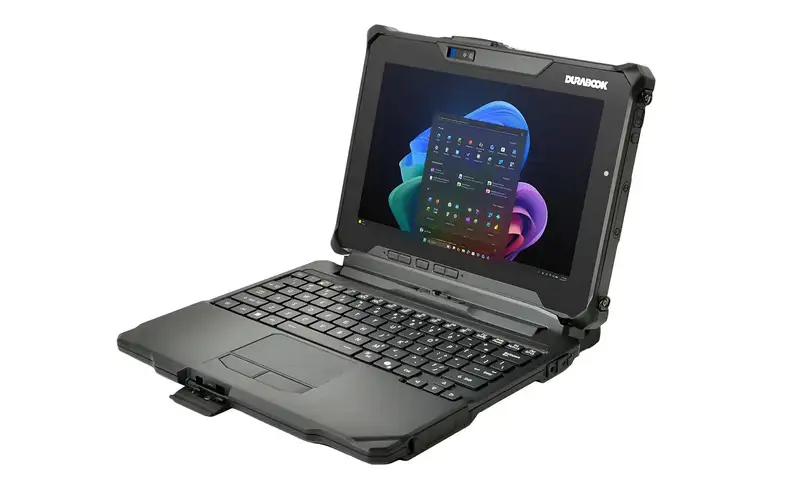
Within our own lineup, the barcode scanner is the most commonly offered capture option: it is listed as a factory option on numerous devices, for instance the Durabook R10, the Durabook R11, the Durabook R11L, the Durabook U11I, and the Durabook S14I (there as a media-bay option). Several Getac devices also offer a 1D/2D barcode reader as an option, for example the Getac S410 G5 and the Getac S510 (each as a 1D/2D imager barcode reader), the Getac T800, the Ex-protected variant Getac T800 EX ATEX, the Getac UX10, and the Getac ZX80. On the Fieldbook handhelds, the barcode scanner is sometimes even permanently built in: the Fieldbook F57G2 has a 1D/2D barcode scanner integrated into its rim, while the Fieldbook N101G2 uses a Zebra SE4710 reader for this purpose. On the Ruggon Sol 7, a 2D barcode scanner is available as an option.
The comparison tables for laptops and tablets also show, in the "Barcode reader" row, which models offer this option.
When Is RFID Worth It?
RFID plays to its strengths wherever objects need to be captured without line of sight, through packaging, or in larger numbers at the same time. Here too, the option is widely represented within our own lineup: an RFID module can be retrofitted to, among others, the Durabook S14I, Durabook S15, Durabook Z14I, Durabook R11, Durabook R11L, and Durabook U11I, as also described in the article RFID and NFC. At Getac, an HF RFID reader is available on, among others, the Getac S410 G5, the Getac S510, the Getac B360 G3, and – already permanently integrated there – the Getac ATEX EX80. On the Getac F110 G7, an RFID reader is listed as a security feature, among other things to protect sensitive data via access control.
For the direct comparison with UHF RFID (see below), one point is decisive: on the Durabook R10 and the Durabook R8, HF and UHF RFID are available as separate, independent expansion modules – clear proof that these are two different technologies for two different purposes, not two names for the same thing. The industry pages Logistics and Transport each explicitly mention the RFID reader as a possible accessory – for Transport, for example, as an RFID card reader combined with a vehicle docking station.
HF RFID and UHF RFID: the Difference in Range
"RFID" is not a single, uniform method but an umbrella term for radio technologies operating in different frequency ranges. Two of these are especially relevant in practice:
- HF RFID (High Frequency): operates in the range around 13.56 MHz. This also includes NFC as a particularly short-range variant of HF technology – according to RFID and NFC, with a maximum range of around 10 cm. HF RFID in the broader sense is used for applications where tag and reader come close together, for instance access control with ID cards or smartcard authentication, as offered on several Getac models (such as the Getac T800) as a "contactless HF RFID/NFC reader" in the SnapBack module combined with a smartcard reader.
- UHF RFID (Ultra High Frequency): operates in a significantly higher frequency range and is designed for greater read ranges than HF RFID. The Fieldbook F57G2 lists a UHF RFID reader compliant with the EPC Global Class 1 Gen 2 / ISO 18000-6B/6C standard as an optional accessory, and on the Fieldbook N80G2, UHF RFID is likewise listed as an option. On the Durabook R10 and the Durabook R8 too, UHF RFID is available as a standalone expansion module separate from the HF/LF module, and on the Getac T800 there is a separate SnapBack module "smartcard reader and UHF RFID".
Specific range or read-speed figures for the individual HF or UHF modules are not documented on the respective product pages and are therefore deliberately not stated here. What can clearly be read from our lineup, however, is this: wherever a manufacturer offers HF and UHF RFID as two separate, mutually exclusive module options – as with the Durabook R10 and the Durabook R8 – these are, technically, two different solutions for different range requirements, and the choice of the right module depends on the specific use case.
Why Does RFID Work Through Packaging but a Barcode Does Not?
The decisive physical difference lies in how the data is transmitted. As described above, a barcode scanner always requires a line of sight – paper, cardboard, film, or any other obstacle between scanner and label prevents reading, as does dirt, creasing, or damage to the printed code itself. RFID, by contrast, uses electromagnetic waves that can pass through many non-metallic materials such as cardboard, plastic, wood, or textiles. A tag placed inside packaging or mounted under a plastic cover can therefore be read without the packaging having to be opened or the label made visible – an advantage that optically based barcode technology fundamentally cannot offer.
Bulk Reading: Capturing Several Objects at Once
Another practical difference is what is known as bulk reading. A barcode scanner fundamentally reads one label per scan – each object must be held individually in front of the scanner, or the scanner must be moved across each label. RFID readers, on the other hand, can – provided the reader used and the tags are designed for it – query several tags within range one after another in quick succession, without each object having to be aligned individually. In practice this means that instead of scanning each pallet or carton individually, an RFID reader can, ideally, capture the entire contents of a shelf or a pallet in a single pass. This is exactly what makes RFID interesting for stocktaking larger inventories – provided every object already carries an RFID tag, which comes with additional cost per object, whereas a barcode label is generally considerably cheaper.
The industry page Logistics puts the relationship between capture technology and error rate this way: "Scan faster, fewer errors" – a principle that applies equally to barcode and RFID, even though the two technologies get there by different routes.
Where RFID Reaches Its Limits: Metal and Liquids
As great as the advantages of RFID are when it comes to penetrating packaging and bulk reading, the physical limits of the technology are equally clear. Metallic surfaces can reflect, shield, or interfere with the radio signals of RFID tags, meaning that a tag mounted directly on or in close proximity to metal may, in some cases, not be read reliably or not be read at all. Liquids have a similarly limiting effect: water and water-containing materials can dampen the radio waves and significantly reduce the range or reliability of the reading. Anyone wanting to use RFID in an environment with a lot of metal – such as a workshop, a machine park, or metal containers – or with liquids must factor in this limitation when planning. A barcode label is not affected by this limitation as long as it remains optically readable and visible to the scanner – one of the reasons why barcode capture remains a reliable alternative in metal-rich environments such as a vehicle workshop or in mechanical engineering. The industry page Workshop accordingly names the barcode scanner as a practical example alongside OBD/diagnostics, machine control, and measurement technology.
Software and Additional Features: It's Not Just Hardware That Matters
Besides the reader itself, software also plays a role in barcode capture. For the Getac models with a barcode option, such as the Getac S410 G5 and the Getac S510, the "Getac Barcode Manager" is listed as companion software. For RFID, there is the added factor that smartcard readers and RFID modules are frequently offered in combination, for example on the Getac T800 in the SnapBack module "combo smartcard reader and contactless HF RFID/NFC reader" or on the Durabook R8 as "smart card reader with LF/HF RFID". Anyone who wants to capture inventory and also implement access control via smartcards at the same time will find both functions combined in a single expansion module on several models.
Barcode or RFID – the Decision at a Glance
In summary, the choice can be narrowed down to three questions:
- Is every object picked up or looked at directly anyway? Then a barcode scanner is usually sufficient – cheaper per label and available as an option on most devices in our own lineup.
- Do objects need to be captured through packaging or without line of sight, or should several objects be captured at once (bulk reading)? Then RFID is the more suitable technology – with HF or UHF RFID used depending on the range required.
- Does capture take place in an environment with a lot of metal or liquids? Then RFID is only reliable to a limited extent, and a barcode scanner is often the more robust choice.
Combinations are also possible: several models in our own lineup – such as the Durabook R10 and the Durabook R8 – offer both a barcode scanner and HF and UHF RFID modules as independent options, so the device can be configured according to the specific use case. Anyone unsure which configuration fits their own workflow will find the selectable options for each model on its product page and in the tablet comparison, which shows which devices offer a scanner or RFID module at all.
Frequently Asked Questions
Can a device support both barcode and RFID?
Yes. On the Durabook R10 and the Durabook R8, the barcode scanner, HF RFID module, and UHF RFID module are listed as separate options and can – depending on configuration – be combined.
Is UHF RFID fundamentally better than HF RFID?
Not as a blanket rule – these are two different frequency ranges for different purposes. The fact that manufacturers, as with the Durabook R10 and R8 modules, offer HF and UHF RFID as separate, mutually exclusive options shows that the right choice depends on the specific use case rather than on a general ranking.
Why does RFID fail on metal?
Metallic surfaces can reflect, shield, or interfere with the radio signals of RFID tags, so readability can be limited in close proximity to metal. A barcode is not affected by this as long as it remains optically visible and readable.
What does bulk reading mean for RFID?
This means that an RFID reader can query several tags within range one after another, without each object having to be aligned individually – unlike a barcode scanner, which fundamentally reads one label per scan.
Is NFC part of HF RFID, or is it its own technology?
According to the article RFID and NFC, NFC is a refined, short-range further development of RFID technology in the HF range – with a maximum range of around 10 cm compared to the greater range of classic RFID applications.
When Barcode and When RFID Is the Right Choice
Barcode and RFID do not rule each other out – they solve different capture problems. A barcode scanner is the more economical option, and one already present on many devices in our own lineup, as long as every object is captured individually and with line of sight – for example in classic goods receipt and dispatch, as described on the industry page Logistics. RFID becomes worthwhile once objects need to be captured through packaging, without line of sight, or in bulk, with HF and UHF RFID used depending on the range required – as seen in the expansion modules of the Durabook R10 and the Durabook R8. RFID has clear limits wherever a lot of metal or liquids are involved – there, the barcode scanner often remains the more robust choice, for instance in the context of the industry page Workshop. Which combination of capture technology and device fits your own use case depends on the specific workflow – the RobustBook comparison tables for laptops and tablets provide a first overview.
If you have questions about the right combination of barcode scanner, HF, or UHF RFID module for your application, the RobustBook team will be happy to help you choose the right model.