Almost every rugged laptop and tablet data sheet states "tested to military standard" – and yet it is one of the least explained claims in the entire text. What MIL-STD-810 technically means as a test standard, which test methods lie behind it, and how the standard has developed historically is described in detail in the article MIL-STD-810 Laptops and Tablets. This article picks up where that one leaves off, but changes the perspective: it is not about the standard itself, but about the buyer's point of view – in other words, what the phrase "tested to military standard" actually promises in a specific data sheet, which version should be listed there, what to look out for when reading it, and where the claim alone says little.
"Tested to Military Standard" – What This Phrase Actually Promises
As explained in the linked foundational article, MIL-STD-810 is not a single test with one pass-or-fail result, but a collection of test methods that each cover different environmental conditions – from drops to vibration to temperature and humidity. For the buyer, this means: if a data sheet states "MIL-STD-810 tested," that alone does not say which of the numerous test methods were actually carried out. This is exactly why it is worth looking beyond the bare standard designation – at the list of conditions actually tested, as stored behind the respective standard designation as a tooltip in the Laptop Comparison Table and the Tablet Comparison Table.
The Version on Paper: MIL-STD-810G and MIL-STD-810H Across the RobustBook Lineup
MIL-STD-810 is updated through revisions and given letters. This can be seen directly within RobustBook's own lineup, because not every model carries the same revision. According to the Laptop Comparison Table, the Durabook S15, the Durabook S14I, and the Durabook Z14I carry the MIL-STD-810H certification, while the Durabook S15AB carries MIL-STD-810G. For tablets, the Tablet Comparison Table lists the MIL-STD-810G certification for the Durabook R11L, the Durabook R11, the Durabook U11I, and the Durabook R8; the Durabook R10 carries no MIL-STD certification in this table.
For the buyer, this leads to a simple but often overlooked point: "tested to military standard" is not a fixed quantity, but has a different revision behind it depending on the model – G or H. Anyone comparing two devices that both have "MIL-STD-810" on the data sheet is therefore not necessarily comparing the same tested basis, unless the revision letters match. The exact designation – MIL-STD-810G or MIL-STD-810H – is therefore one of the first things worth checking in the data sheet or comparison table, before drawing conclusions from the bare mention of "military standard."
Which Conditions Actually Stand Behind the Claim
The decisive difference between a mere marketing claim and a reliable specification does not lie in the revision alone, but in the list of conditions actually tested. This list is stored as a tooltip behind the respective MIL-STD designation in the Laptop Comparison Table and differs considerably between models:
- For the Durabook S15, MIL-STD-810H is tested for the conditions of drops, shocks, vibration, dust, altitude, high/low temperatures, and humidity.
- For the Durabook S14I, MIL-STD-810H is tested for drops, shocks, vibration, rain, dust, altitude, freeze/thaw, high/low temperatures, thermal shock, and humidity.
- For the Durabook Z14I, the same comprehensive list applies as for the S14I – drops, shocks, vibration, rain, dust, altitude, freeze/thaw, high/low temperatures, thermal shock, and humidity.
- For the Durabook S15AB, MIL-STD-810G is tested according to a significantly narrower scope: drop, shock, and vibration.
This comparison shows why the bare standard designation, without the underlying list of conditions, carries little weight on its own: a device can be certified "to MIL-STD-810" and still cover only a fraction of the conditions that another device with the same standard designation has gone through. Anyone looking for a device for use in humidity, rain, or strong temperature fluctuations should therefore not stop at "MIL-STD-810 tested," but should check specifically whether rain, freeze/thaw, humidity, or thermal shock are actually included in the tested list.
MIL-STD-461G: The Second Standard That Often Appears in the Same Sentence
Alongside MIL-STD-810, MIL-STD-461G additionally appears for some models – a separate standard that has nothing to do with drops, temperature, or humidity, but concerns electromagnetic properties. According to the Laptop Comparison Table, the Durabook Z14I carries the MIL-STD-461G certification in addition to MIL-STD-810H, tested for the conditions of conducted and radiated emissions as well as susceptibility to interference. According to the Tablet Comparison Table, the Durabook R11L, the Durabook R11, the Durabook U11I, and the Durabook R8 also carry the MIL-STD-461G certification in addition to MIL-STD-810G.
For the buyer, this means: anyone reading "MIL-STD-810" and "MIL-STD-461" in the same section of a data sheet should not read the two standards as interchangeable synonyms for "rugged." MIL-STD-810 concerns mechanical and climatic loads, while MIL-STD-461 concerns electromagnetic compatibility – relevant, for example, where a device is operated near radio equipment or sensitive electronics, such as in the environment of military or public safety use. A device can carry one of the two standards without carrying the other – within RobustBook's own lineup, this is the case for the Durabook S15, Durabook S14I, and Durabook S15AB, which, according to the comparison table, carry MIL-STD-810 but do not list a MIL-STD-461G certification.
The Drop Protection Value: Centimeters Instead of a Marketing Word
One area where the limits of the bare MIL-STD claim show up particularly clearly is drop protection. "Drop-tested to military standard" initially sounds uniform – but the specific drop height from which a device passes the test differs considerably within RobustBook's own lineup. According to the Laptop Comparison Table, drop protection up to 120cm applies to the Durabook S15 and the Durabook S14I, up to 180cm for the Durabook Z14I, and up to 90cm for the Durabook S15AB. For tablets, according to the Tablet Comparison Table, drop protection up to 120cm applies to the Durabook R11L, the Durabook R11, and the Durabook R8, and up to 180cm for the Durabook U11I; no value is listed in this row for the Durabook R10.
These figures are the actually meaningful part of the claim – not the word "military standard" itself. Two devices can both be "drop-tested to MIL-STD-810" and still show a difference of 90cm between the tested drop heights, as the comparison between the Durabook S15AB (90cm) and the Durabook Z14I (180cm) shows. Anyone using drop protection as a purchase criterion should therefore look specifically for the centimeter figure in the comparison table or data sheet, rather than relying on the bare mention of the standard.
Where the Claim "Tested to Military Standard" Alone Says Little
The example of the Durabook S15AB shows clearly where the bare standard designation reaches its limits. According to the Laptop Comparison Table, the S15AB is certified to MIL-STD-810G, tested for drop, shock, and vibration – while at the same time having the lowest drop protection value in the series (90cm) and lacking the checkmarks shown in the same table for the S15, S14I, and Z14I for port covers, humidity 5% to 95%, and an operating temperature of −20°C to 60°C. The S15AB therefore correctly carries the designation "tested to military standard," but according to the table it covers a significantly narrower stress spectrum than the other models in the same series.
This is not a contradiction, but shows exactly the pattern that matters for the buyer: the claim "tested to military standard" is true as long as any test method of the standard was carried out – but it says nothing about how extensive that testing was. A device with a narrow test scope and a device with a broad test scope can both correctly have "MIL-STD-810" on the data sheet. The difference only becomes visible when, in addition to the standard designation, the list of tested conditions, the drop protection value in centimeters, and the humidity and operating temperature figures are compared.
Reading a Data Sheet Correctly: What to Watch for When Comparing
A practical order for reading a data sheet can be derived from the preceding sections:
- Check the revision letter: Does the data sheet say MIL-STD-810G or MIL-STD-810H? Within RobustBook's own lineup, the S15, S14I, and Z14I carry revision H, while the S15AB and the tablets mentioned carry revision G.
- Check the tested conditions: Which of the possible stresses – drop, shock, vibration, dust, rain, altitude, freeze/thaw, temperature, thermal shock, humidity – are specifically listed, and which are missing from the list?
- Look for the drop protection value in centimeters: The bare note "drop-tested" does not replace the specific drop height listed per model in the comparison table.
- Watch for a second standard: If MIL-STD-461G is also listed, this concerns electromagnetic compatibility and not mechanical or climatic durability – relevant for use near radio equipment, for example in military or public safety settings.
- Also check additional ruggedness figures: Operating temperature, humidity, and IP protection class figures stand independently alongside the MIL-STD certification and are tested separately – for more on this, see the articles IP57 and the Other IP Protection Classes in Detail and The Different IP Protection Classes.
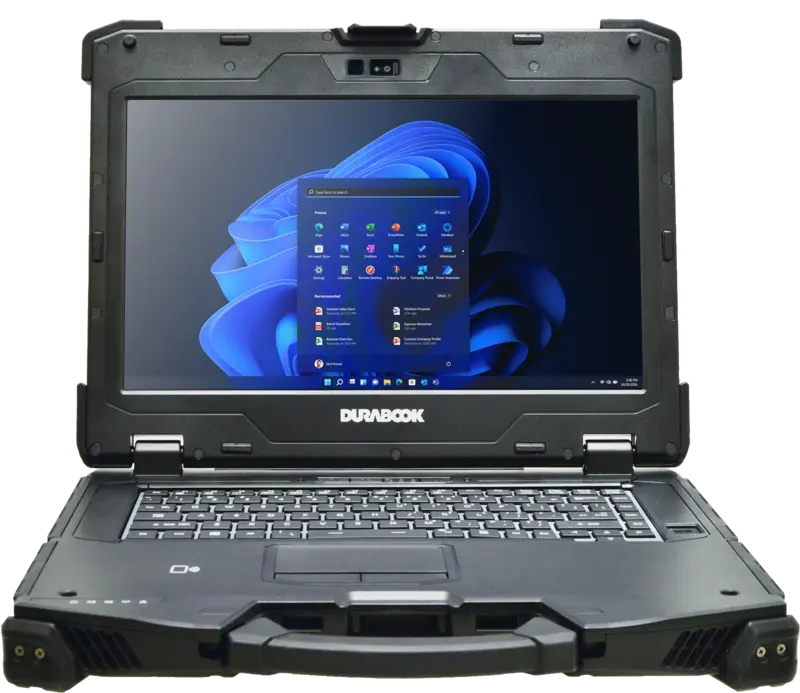
MIL-STD-810 Across RobustBook's Own Lineup at a Glance
In summary, comparing the data sheet claims with the comparison table shows the following picture for the current laptop and tablet models:
- Durabook S15: MIL-STD-810H, drop protection up to 120cm.
- Durabook S14I: MIL-STD-810H, drop protection up to 120cm.
- Durabook Z14I: MIL-STD-810H plus MIL-STD-461G, drop protection up to 180cm.
- Durabook S15AB: MIL-STD-810G, drop protection up to 90cm.
- Durabook R11L: MIL-STD-810G and MIL-STD-461G, drop protection up to 120cm.
- Durabook R11: MIL-STD-810G and MIL-STD-461G, drop protection up to 120cm.
- Durabook U11I: MIL-STD-810G and MIL-STD-461G, drop protection up to 180cm.
- Durabook R8: MIL-STD-810G and MIL-STD-461G, drop protection up to 120cm.
- Durabook R10: no MIL-STD certification according to the comparison table.
This overview does not replace looking at the full Laptop Comparison Table and Tablet Comparison Table, where, alongside MIL-STD, IP protection class, port covers, humidity range, and operating temperature are compared directly per model. It does show, however, that "tested to military standard" within RobustBook's own lineup is not a single fixed statement, but reaches further or less far depending on the model.
Military Standard as a Starting Point, Not an Endpoint of Verification
"Laptop tested to military standard" is a correct but incomplete statement as long as it lacks the revision letter, the list of tested conditions, and the concrete figures such as drop height, humidity range, and operating temperature. As described in the foundational article MIL-STD-810 Laptops and Tablets, MIL-STD-810 is a broad collection of test methods – which of these a specific device has actually gone through is not stated in the standard designation itself, but in the detailed information alongside it. For the purchase decision, it is therefore always worth taking a second look: moving from the bare mention of "military standard" to the revision, the tested conditions, and the concrete figures in the Laptop Comparison Table or the Tablet Comparison Table.
If you have questions about the right MIL-STD certification for your specific application, the RobustBook team is happy to help you choose the suitable model.