Almost every product page for a rugged laptop or tablet states a drop height: "90 cm", "120 cm", "1.80 m". On its own, however, this figure says little about how a device was actually tested. The general structure of the military standard MIL-STD-810 is already described in the article MIL-STD-810 laptops and tablets. This article goes into depth specifically on the drop-protection part: how a drop test is set up, what framework conditions are needed to make a plain height figure meaningful in the first place, and why it matters whether a device was switched on during the drop test or not.
What the drop-protection part of MIL-STD-810 actually tests
MIL-STD-810 is not a single test but a collection of test methods for different environmental stresses. The article MIL-STD-810 laptops and tablets names the "mechanical shock test" as one of these stress types: the device must withstand sudden mechanical shocks or abrupt changes in motion. In the laptop comparison table, this test category is specifically listed as "drops, shocks, vibration, dust, altitude, high/low temperatures, humidity", against which the Durabook S15, S14I and Z14I models are certified under MIL-STD-810H. Drop protection is therefore one part of a larger test catalogue, not a standalone mark with a single fixed test procedure.
Important for understanding the figures cited later: a "MIL-STD-810" certification initially only states that a device was tested using this standard's test methods. Which specific drop height was actually achieved, which edges and corners were included, and how many times the device was dropped is a separate matter entirely – and that is precisely what the following sections put into context.
The test setup in detail: drop height, surface, number of drops, edges and corners
How a drop test actually plays out is described in the section on rugged tablets in the article MIL-STD-810 laptops and tablets as follows: "That is a total of 26 drops onto all surfaces, edges and corners of the tablet." It further states: "Each of the drop-resistant tablets is dropped directly onto several surfaces such as plywood and concrete from several heights, typically 1.2 m to 1.8 m." From this description, the central test parameters of a drop test can be derived:
- Drop height: not a single value, but typically a range – 1.2 m to 1.8 m in the example cited.
- Surface: the device is dropped onto several surfaces of differing hardness, such as plywood and concrete. A single surface is not sufficient for the test.
- Number of drops: in the process described, this means 26 individual drops, not a single one-off drop test.
- Impact points: testing covers the flat side. It specifically also covers the edges and corners of the device, since these are the parts that most often hit the ground first in everyday use.
Only together do these four parameters give a complete picture of a drop test. A product page that simply states "drop-resistant up to 1.80 m" as a rule gives only the first of these four parameters – the upper drop-height value. Whether testing was also carried out on concrete or only on a softer surface, how many individual drops were performed, and whether edges and corners were included cannot be read from the plain height figure alone.
One point remains explicitly open here: the cited description with 26 drops, the surfaces plywood and concrete, and the height range 1.2 m to 1.8 m comes from the general section on rugged tablets in the existing MIL-STD-810 article. For the individual laptop and tablet models in our own range, there is no per-device documentation confirming each of these four parameters individually – the product pages themselves practically always state only the drop height.
Why "drop height 120 cm" alone says little
In our own range, product pages contain very differently worded drop-protection specifications, each without further test conditions:
- Durabook S15: "IP53-certified, 4ft (1.2m) drop resistance".
- Durabook S14I: "Drop-resistant from up to 1.2 metres (4ft drop)".
- Durabook S15AB: "Drop resistance: withstands drops from up to 0.9 m (3 feet)".
- Getac T800: "Drop protection from 1.80 m (6 feet)".
- Getac X600: "Drop resistance: withstands drops from up to 0.9 m (3 feet)".
- Getac UX10: "Drop-resistant: withstands drops from up to 1.80 m in height".
- Fieldbook P101: "drop-resistant up to 1.2 metres".
- Fieldbook P122 G2: "drop-resistant up to 1.22m".
- RuggON SOL 7: "drop-resistant up to 1.5 metres".
None of these specifications additionally states the tested surface, the number of drops, whether edges and corners were included, or the temperature at which testing took place. That does not mean these devices were tested less thoroughly or less precisely than the tablets in the example cited above – it only means the datasheets themselves do not repeat these details. Two devices with the same stated drop height of 1.2 m are therefore not automatically tested under identical conditions: without stating the surface, the number of drops and the impact points, no reliable ranking between two models can be built from the figure alone.
For a purchasing decision, this means in practice: a higher figure on the datasheet is an indication of more headroom, but not an exact benchmark for comparison, as long as the test conditions behind it are not known. Anyone needing a reliable assessment should read the drop height as a rough guide value, not as a precisely comparable metric between different manufacturers.
Testing while powered on versus testing while switched off
Another point that a plain height figure does not reveal is the power state of the device during the drop test. The existing MIL-STD-810 article explicitly describes for rugged tablets: "We switch on every drop-resistant mobile computer for the tests, in order to measure system functionality during the MIL-STD-810 drop tests."
The difference is substantively significant: a device that is dropped while switched off and looks intact afterwards has only shown that the housing and the components inside mechanically survive the impact. Whether the mainboard, memory, display and ports continue to function correctly during or immediately after impact is not thereby demonstrated. If, on the other hand, the device is dropped while switched on and its system functionality is checked during or after the drop, the finding goes further: it confirms mechanical resilience. It equally confirms functional resilience at the moment of the load.
Here too, a limitation must be honestly stated: the cited statement about switching devices on during the test appears in the existing article's section on tablets. Whether the same approach – testing while switched on rather than switched off – also applies in exactly this form to every individual laptop model in the range cannot be determined from the available product pages. Anyone who needs to know this difference reliably for a specific purchasing decision should ask about this point directly rather than inferring it from the general drop-height figure.
Drop-protection values across our own range at a glance
A structured overview with directly comparable values is provided by the Laptop comparison table and the Tablet comparison table. For laptops, the row "Drop protection up to" there shows the following values:
- Durabook S15: 120 cm
- Durabook S14I: 120 cm
- Durabook Z14I: 180 cm
- Durabook S15AB: 90 cm
For tablets, the same row in the Tablet comparison table shows the following values:
- Durabook R11L: 120 cm
- Durabook R11: 120 cm
- Durabook U11I: 180 cm
- Durabook R8: 120 cm
- Durabook R10: no value listed (field in the table marked with "–")
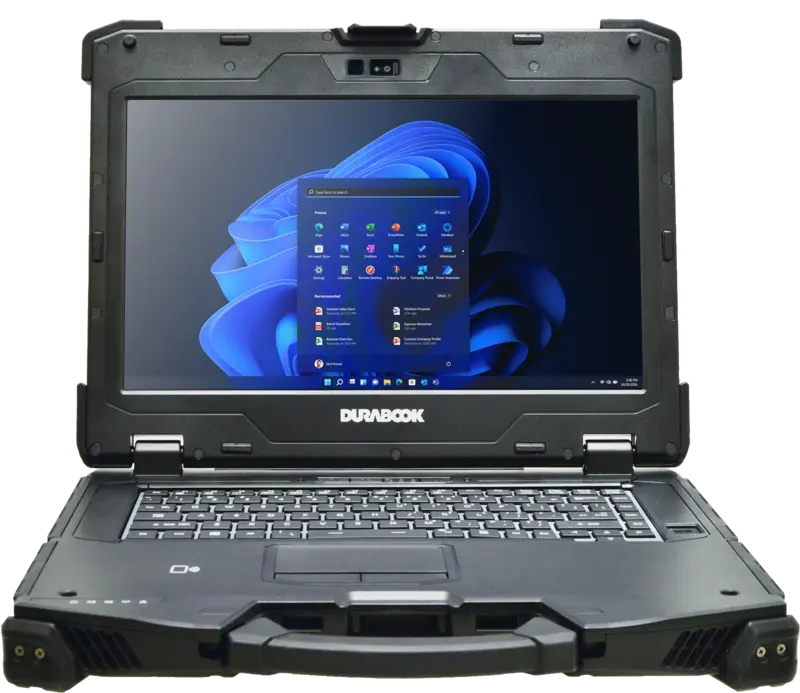
For further devices in the range that are not listed in either comparison table, drop heights are also stated on the respective product pages, for example the Getac T800 (1.80 m), the Getac X600 (0.9 m), the Getac UX10 (1.80 m) or the Fieldbook P101 (1.2 m). The spread from 90 cm to 180 cm across the entire range shows: drop protection is not a fixed property of MIL-STD-810 certification itself, but a value that varies depending on the device class and design.
What datasheets leave open – and what that means for selection
In summary, comparing our own product pages reveals a recurring pattern: almost always the maximum drop height is stated, usually also converted into feet, and often the underlying MIL-STD-810 revision as well (in the Laptop comparison table, for example, MIL-STD-810H for the S15, S14I and Z14I, and MIL-STD-810G for the S15AB). By contrast, the following are, as a rule, not repeated on the product pages:
- the tested surface (for example plywood or concrete),
- the number of individual drops,
- whether edges and corners were specifically included,
- the power state of the device during the drop test (switched on or switched off),
- the ambient temperature during testing.
This is not a peculiarity of individual models but an industry-wide pattern: datasheets are designed for a short, comparable metric, not for the complete reproduction of a test protocol. Anyone who needs a reliable statement on the exact test conditions of a particular model for a procurement decision will not find this level of detail on the product page itself, but at most in the manufacturer's underlying test report.
Drop protection as one criterion among several
Drop protection is only one of several ruggedness factors that should be considered together when selecting a rugged laptop or tablet. How the IP protection class against dust and water is structured is explained in the article IP57 and the other IP protection classes in detail. How MIL-STD-810 certification should be assessed overall – beyond drop protection, for example regarding vibration, altitude and humidity – is described in the article MIL-STD-810 laptops and tablets. Only the interplay of IP protection class, MIL-STD-810 certification and the specific drop height produces a realistic picture of how rugged a device actually is for the intended application.
Anyone looking for a device for use on construction sites, in a workshop, in field service or in industry should therefore always weigh the drop height together with the rest of the relevant model's usage profile – such as weight, screen size or available interfaces, which can likewise be found in the Laptop comparison table and the Tablet comparison table.
Frequently asked questions
Is a higher drop-protection figure automatically better?
A higher stated drop height initially only shows greater headroom relative to the tested load. Whether two devices with different drop heights are actually directly comparable also depends on the surface, the number of drops and the impact points – details that are, as a rule, not provided on the product pages.
What does "tested while powered on" mean for the drop test?
It means the device was switched on during or immediately after the drop test and its system functionality was checked – not just whether the housing remained externally intact. The existing MIL-STD-810 article explicitly describes this approach for rugged tablets.
Why do the stated drop heights differ so much between models?
The drop height depends on the design, device class and target group of the relevant model. In our own range, the spread runs from 90 cm (for example, Durabook S15AB or Getac X600) to 180 cm (for example, Durabook Z14I or Getac T800) – a uniform test setup across all models cannot be inferred from this.
Where can I find the drop-protection values for all RobustBook devices at a glance?
For the Durabook laptops and tablets, the Laptop comparison table and the Tablet comparison table provide the row "Drop protection up to" directly in the model comparison. For other devices, such as Getac, Fieldbook or RuggON, the figure is stated on the respective individual product page.
What the MIL-STD-810 Drop Test Actually Covers
The drop-protection part of MIL-STD-810 is more than a single height figure: only the drop height, the tested surface, the number of individual drops, the edges and corners included, and the power state of the device during the test together give a complete picture of the test. The description in the existing MIL-STD-810 article specifically states, for rugged tablets, 26 drops onto several surfaces such as plywood and concrete, from heights typically between 1.2 m and 1.8 m, with the device switched on. On the individual product pages in the range – from the Durabook laptops and Durabook tablets to Getac, Fieldbook and RuggON models – as a rule only the maximum drop height is stated, usually also converted into feet. Anyone using drop height as a selection criterion should therefore read it as a rough guide value, and ask specifically about the underlying test conditions where needed, rather than comparing only the figure on the datasheet.
If you have questions about drop protection or about the right device choice for your specific application, the RobustBook team will be happy to help.