Which housing material is fundamentally better suited – aluminum-magnesium alloy or plastic – is already answered in detail by the article Aluminum-Magnesium Alloy vs. Plastic Housing: it compares strength, thermal conductivity, corrosion resistance, weight, and cost of the two material groups. This article does not repeat that comparison; instead, it explores the question that remains open there: what does the material specification actually mean once it is placed alongside the real test values of the individual models? To answer this, we draw on the data sheets and comparison tables of the RobustBook devices – with a partly surprising result: the same housing material does not automatically lead to the same protection class or corrosion resistance.
Same Material, Different Corrosion Protection – What the Salt Spray Test Shows
The blog article Rugged Laptops notes that the Durabook S15AB, the Durabook S14I, and the Durabook Z14I all have a housing made of aluminum-magnesium alloy. Even so, the three devices differ considerably in what they are actually tested and certified against: according to the same article, only the Durabook Z14I is tested under MIL-STD-461G and MIL-STD-810H against, among other things, salt spray (corrosion), while the S15AB and S14I either fail this test or do not undergo it at all, according to the article's conclusion.
This is an important distinction from the pure material comparison: an aluminum-magnesium alloy is inherently more corrosion-resistant than untreated steel, as already explained in the material comparison article. However, the material specification alone does not say whether a specific device also survives road salt on winter streets, salt water near the coast, or salty industrial air undamaged. What matters is whether the manufacturer has actually tested for exactly this stress as part of the MIL-STD-810 test methods. What a MIL-STD-810 salt spray test specifically covers is described in the article MIL-STD-810 Laptops and Tablets: it lists salt spray, alongside rain, solar radiation, thermal shock, and fungus resistance, among the additional test points that go beyond the basic test.
In practice, this means: anyone looking for a device for use with road salt or in coastal areas should ask specifically about the salt spray certification – not about the housing material. Two laptops with an identical material can perform differently in this discipline, because coating, workmanship, and test scope also play a role in addition to the material itself. Anyone who needs a device with proven salt spray protection will currently find only one RobustBook laptop model with this certification: the Durabook Z14I.
Material and Sealing Concept: Why Port Covers Help Determine the IP Rating
What the IP digits actually mean is explained in detail in the articles IP57 and the Other IP Protection Classes in Detail and The Different IP Protection Classes. One point from these is important for the material comparison: a device is tested and certified for a specific combination of dust and water protection – not automatically because of its housing material. A metal housing alone therefore does not guarantee a higher IP rating.
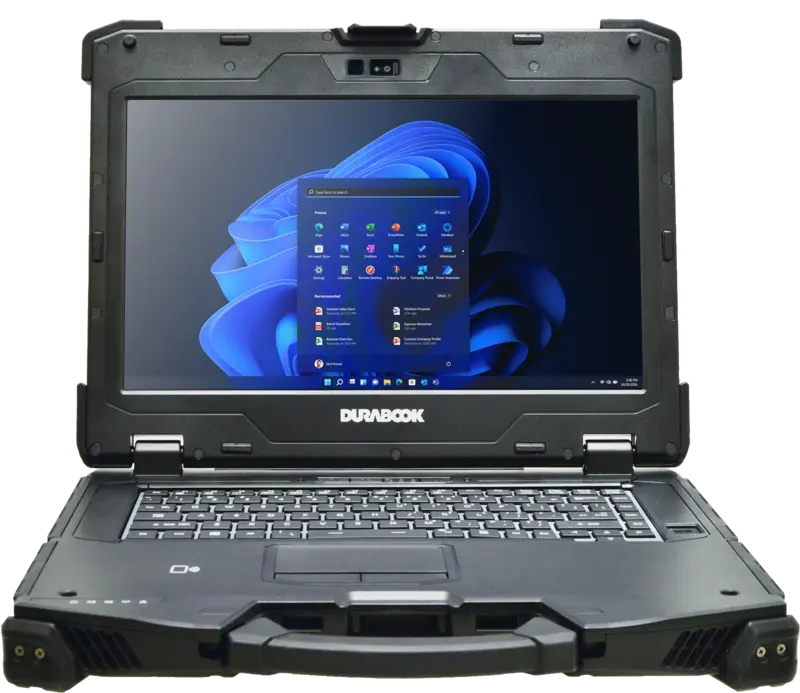
The Laptop Comparison Table shows this with a concrete example: the Durabook S15 has port covers and achieves IP5X (full dust protection, no tested water rating). According to the same table, the Durabook S15AB has no port covers and likewise stays at IP5X. The Durabook S14I has both port covers and a tested water rating (IP53); the same applies to the Durabook Z14I, which even reaches IP65 – the highest class in the current laptop lineup. Both models with an assigned water rating have port covers; the model without port covers remains without a water rating.
No simple automatism can be derived from this – port covers are not sufficient proof of a higher IP rating, as the example of the S15 versus the S15AB shows. But the data suggests that, so far, a tested water protection rating has only been assigned to current RobustBook laptops in combination with port covers. The housing material primarily protects the closed surface from scratches, impacts, and deformation; whether dust or water penetrates through an opening – USB port, charging socket, battery compartment – depends on the seal at that specific opening, regardless of whether the housing is made of metal or plastic.
This pattern also shows up in tablets: according to the Tablet Comparison Table, the Durabook models R11L, R11, U11I, and R8 all consistently have port covers and each reach IP65 or IP66 – the highest classes across the entire RobustBook lineup according to this table.
Weight in Relation to Screen Size and Housing Thickness
A common assumption is: a larger screen means a heavier device. The company's own comparison data shows that this rule of thumb does not reliably hold true for rugged laptops. According to the Laptop Comparison Table, the Durabook S14I, with a 14.0-inch display size, weighs 2.3 kg, while the Durabook Z14I, with the identical 14.0-inch display size, weighs 3.6 kg – a difference of 1.3 kg with exactly the same screen diagonal. The reason lies not in the display but in the protective equipment: according to the same table, the Z14I achieves drop protection up to 180 cm (compared to 120 cm for the S14I), the IP65 protection class (compared to IP53), and – as described above – an additional salt spray certification. The article Rugged Laptops adds concrete housing thicknesses: according to this, the Durabook S14I is 38 mm thick, the Durabook Z14I 50 mm – more volume for damping elements, seals, and a more rigid chassis.
Comparing the two 15.6-inch models shows a different picture: according to the comparison table, both the Durabook S15 and the Durabook S15AB weigh 2.6 kg each – despite the larger display compared to the 14-inch S14I, that is only 0.3 kg more. According to the figures from the article Top 3 Rugged Laptops Compared, the housing thickness of the S15AB, at 30 mm, is even lower than that of the S14I (38 mm). Screen size, weight, and housing thickness therefore do not behave proportionally to one another in the current RobustBook laptops, but depend more strongly on the respective protection level.
For tablets, this comparison cannot be made with the same precision using the available data: the Tablet Comparison Table lists the weight of the R11L, R11, U11I, and R8 models as "depending on configuration," without a fixed kilogram figure. Fixed values are available for display size, however: the R11L, R11, and U11I each have 11.6 inches, the Durabook R8 has 8 inches, and the Durabook R10 has 10.1 inches. Anyone who wants to compare tablet weights precisely should therefore refer directly to the values listed for their own configuration on the respective product pages.
Fanless Cooling: Why the Material Matters More With Passive Cooling
The material comparison article already explains that aluminum-magnesium alloys conduct heat better than plastic. This property carries more weight in devices without a fan, because no active airflow is available for cooling – all the heat has to be dissipated passively through the housing into the environment. This is exactly the case for part of the RobustBook tablet lineup: the product page for the Durabook R11L explicitly describes the device with a "slim and fanless design," and the product page for the Durabook U11I likewise mentions a "fanless design." The product photos of the Durabook R8 are also labeled "fanless" or "compact yet fanless" in the file name and alt text.
For fanless devices, this means: the housing material takes on part of the job that a fan performs in actively cooled laptops – it has to absorb the heat generated during operation and release it through the housing surface, without a fan supporting the heat flow. According to the overview page for outdoor devices, the housing of all RobustBook outdoor devices is made of an aluminum-magnesium alloy – this specification therefore applies both to the actively cooled laptops and to fanless tablets such as the R11L and U11I. With a fanless plastic housing, the weaker thermal conductivity would have a greater impact, because less heat can be released from inside the device into the environment; with a metal housing that has a fan, the active airflow at least partly compensates for the housing's weaker thermal conductivity. Fanless tablets are therefore the device type in which the choice of material has the most direct effect on heat dissipation.

Magnesium as a Frame Instead of a Full Housing: Another Variant
The material comparison usually distinguishes broadly between a "metal housing" and a "plastic housing." In practice, a third variant exists in between: magnesium alloy as a load-bearing frame, combined with plastic elements on the outer skin. According to its own product page, the Fieldbook RC300 from the RobustBook lineup is equipped with a "magnesium alloy frame" – here the metal carries the mechanical load, while the visible outer surface is not necessarily made entirely of metal. For the Getac X500, according to the product page, it is the other way around: there, the description explicitly mentions a "solid housing made of a magnesium alloy," or "full magnesium alloy" – here the entire outer shell consists of the alloy.
This distinction is relevant when choosing a device, because a magnesium alloy frame brings different properties than a continuous magnesium or aluminum-magnesium housing: the load-bearing structure benefits from the high rigidity of the alloy, while the weight and thermal conductivity of the outer skin additionally depend on the materials used there. Anyone who relies solely on the "magnesium alloy" specification should therefore check whether it refers to the frame, to individual components such as the removable hard drive, or to the complete housing.
Why the Same Housing Material Does Not Mean the Same Protection Class
The fundamental comparison between aluminum-magnesium alloy and plastic – strength, weight, thermal conductivity, cost – has already been answered comprehensively in the article Aluminum-Magnesium Alloy vs. Plastic Housing. The company's own product data additionally shows: the same housing material does not automatically mean the same protection class or the same corrosion resistance. Whether a device withstands salt spray, immersion, or water jets also depends on the specific test it has undergone and on the sealing concept at its openings and ports. For current RobustBook laptops, weight and housing thickness follow the protection level more closely than the screen size alone, and in fanless tablets such as the Durabook R11L or U11I, the thermal conductivity of the housing carries extra weight, because no active airflow contributes to cooling.
For choosing a rugged laptop or tablet, this means: the "aluminum-magnesium alloy" material specification is a good starting point, but it does not replace looking at the specific IP rating assigned, the drop protection value, and – depending on the deployment location – a salt spray certification. A complete overview of all values per model is provided by the Laptop Comparison Table and the Tablet Comparison Table.
Frequently Asked Questions
Is an Aluminum-Magnesium Housing Automatically More Corrosion-Resistant Than Plastic?
In principle yes, the alloy is inherently more corrosion-resistant. However, whether a specific device also withstands salt spray in the sense of the MIL-STD-810 test methods is only shown by the certification actually granted – as the example of the Durabook Z14I compared to the S14I and S15AB shows, which, according to the company's own product data, share the same housing material but have different test evidence.
Does the Housing Material Determine the IP Protection Class?
Not directly. The IP class is tested for the combination of dust and water protection and depends largely on the seal at openings such as ports and the battery compartment, not solely on the material of the closed housing surface.
Why Do Two Devices With the Same Display Size Weigh Different Amounts?
Because the weight depends more strongly on the protection level – drop protection, IP class, additional certifications – and the resulting housing thickness than on the display itself, as the comparison between the Durabook S14I and Z14I shows.
Why Does the Housing Material Play a Bigger Role in Fanless Tablets?
Because without active airflow, all the operating heat has to be released passively through the housing surface. As a result, the thermal conductivity of the material has a more direct effect on cooling than in devices with a fan.
If you have questions about the right protection class or the suitable housing material for your application, the RobustBook team is happy to help you choose the right model.