An ordinary rugged notebook or tablet withstands dust, shocks and splashing water – but that does not cover every environment in which a device is expected to be "rugged". Wherever flammable gases, vapours or dusts can occur in the air, a high IP or MIL-STD rating alone is not enough: a separate, legally regulated certification under ATEX or IECEx is required. This article explains what explosion protection means, how the Ex zones are classified, in which operations zone-certified devices become necessary, and what structurally distinguishes an Ex device from an ordinary rugged device – and shows which Ex-certified models in the RobustBook range are certified for which zone.
What does explosion protection mean?
Explosion protection refers to all technical and organisational measures that prevent an explosion from occurring in an environment containing flammable gases, vapours, mists or dusts. An explosion requires three things at the same time: a flammable substance in sufficient concentration, oxygen (usually from the surrounding air), and a source of ignition. An electrical device – whether a notebook, tablet or other piece of equipment – can itself become a source of ignition: through a spark when plugging in a cable, through electrostatic charging of the housing, or through a surface that becomes too hot. This is precisely why, in areas where an explosive atmosphere can be expected to occur, only devices that have been specifically tested and certified for that purpose may be used. In Europe, this certification is covered under the umbrella term ATEX – named after the EU directive "ATmosphères EXplosibles" – and is additionally covered internationally by the IECEx system, an internationally recognised certification based on the same underlying principles.
For users, this means in concrete terms: a device without ATEX or IECEx certification must not, as a rule, be used in a correspondingly classified zone, regardless of how rugged it otherwise is. A device with IP66 and MIL-STD-810H withstands dust, rain and drops – but it says nothing about whether it may safely be operated in an atmosphere containing explosive gases. That is the key difference between "rugged" and "Ex-protected": ruggedness describes a device's mechanical and climatic resilience, while Ex protection describes whether a device can itself become a source of ignition in its environment.
How are the Ex zones classified?
Potentially explosive areas are not classified generically, but according to the frequency and duration with which an explosive atmosphere occurs there. There are separate sets of zones for gases, vapours and mists on the one hand, and for combustible dusts on the other:
Zones for gas, vapour and mist
- Zone 0: areas in which an explosive gas atmosphere is present continuously, for long periods, or frequently.
- Zone 1: areas in which an explosive gas atmosphere can occasionally occur.
- Zone 2: areas in which an explosive gas atmosphere normally does not occur, or occurs only briefly.
Zones for combustible dust
- Zone 20: areas in which an explosive dust-air atmosphere is present continuously, for long periods, or frequently.
- Zone 21: areas in which an explosive dust-air atmosphere can occasionally occur.
- Zone 22: areas in which an explosive dust-air atmosphere normally does not occur, or occurs only briefly.
A device certified for a particular zone is approved exclusively for that zone and the conditions tested for it. Certification for Zone 2/22, for example, means that a device is approved for areas with rare, brief gas or dust hazards – not automatically also for the considerably stricter Zone 0/20, where an explosive atmosphere is present continuously or for long periods. Which zone actually applies at a given site is determined by the operator as part of the site's explosion protection documentation.
Which operations need zone-certified devices?
Potentially explosive areas arise wherever flammable gases, vapours, mists or dusts can occur in the air – the cause is usually the particular production process or the material being stored or processed. Typical examples include:
- Chemical industry and chemical processing: handling solvents, reaction gases or flammable liquids can create explosive gas or vapour atmospheres.
- Paint shops: processing paints and coating materials can allow flammable solvent vapours to accumulate in the air, particularly in spray booths.
- Tank farms and the oil and gas industry: explosive gas atmospheres are a central risk in the storage, extraction and handling of fuels – an application area for which Getac explicitly specifies the EX80 tablet with certification for ATEX zones 0/20 as well as for petrochemical plants.
- Mills and silos: processing and storing grain, flour or other fine-grained bulk materials can cause combustible dust to occur in the air at explosive concentrations.
Explosive atmospheres can also arise at certain process steps in pharmaceutical production: Getac explicitly specifies the F110-EX tablet for professionals in oil and gas extraction, chemical processing and pharmaceutical production who work in ATEX zones 2/22. The same principle applies to all the operations named above: as soon as an explosive atmosphere can be expected to occur in a work area, only devices certified for the applicable zone may be used there. For operations that generally rely on rugged, dust-tight and splash-protected devices without an Ex zone being present, the overview at Industry offers an entry point into the regular rugged range.
What structurally distinguishes an Ex device from an ordinary rugged device?
A zone-certified device does not differ from an ordinary rugged device merely by a test mark. It differs through structural measures that ensure the device itself cannot become a source of ignition under any circumstances. The following characteristics can be evidenced from the product information of the RobustBook Ex models:
Type of protection and marking
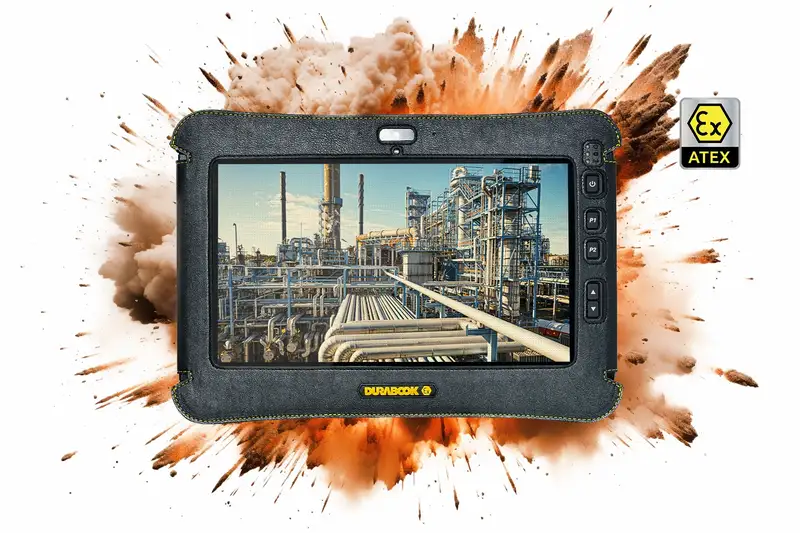
According to its product page, the Durabook U11I-EX carries the certification "ATEX Zone 2/22" with the Ex marking "Ex II 3G Ex ic IIC T4 Gc" for the gas area and "Ex II 3D Ex ic IIIB T135°C Dc" for the dust area. Such a marking specifies, among other things, the type of protection, the equipment group, the temperature class and the equipment category – details that do not exist for an ordinary rugged device without Ex certification.
Wireless instead of plugged connections in hazardous zones
According to its product page, the Getac T800-EX deliberately relies on wireless safety: Bluetooth 4.0 and 3D antenna technology are intended to minimise risks in hazardous zones by avoiding the dangerous plugging and unplugging of cables in the Ex zone. Connecting and disconnecting cables can itself generate a spark – a risk that plays no particular structural role for an ordinary rugged device without an Ex design.
Ex-certified accessories instead of standard accessories
Ex devices in the RobustBook range are offered with accessories specifically tested for Ex use, rather than the base model's standard accessories. According to its product page, the Getac EX80 comes with an ATEX-certified office docking station along with a charger for six batteries (six-bay charger). For the Durabook R8-EX, dedicated accessories intended for the Ex variant are listed, including an "R8-EX ATEX protective cover" and an "R8-EX ATEX screen protector", which do not exist in this form for the regular R8. The same principle applies to the Durabook U11I-EX, with its own "U11I-EX ATEX protective cover" and its own "U11I-EX ATEX screen protector". Ordinary accessories for a rugged device – such as a standard battery or a regular protective cover – are also, as a rule, not simply suitable for use in an Ex zone, since they have not been tested for that purpose.
In summary: while an ordinary rugged device is tested primarily for mechanical and climatic resilience and against the ingress of dust and water (see also IP57 and the other IP protection classes in detail and MIL-STD-810 for laptops and tablets), an Ex device has testing and design against ignition sources added as a separate, additional requirement – with its own marking, its own structural measures and its own, separately certified accessories.
Which Ex-certified devices are available in the RobustBook range?
Several laptop and tablet models are available in the RobustBook range as dedicated Ex variants. An overview of the zone and standard information stated on the respective product pages:
- Getac EX80: certification for ATEX zones 0/20; according to the product page, specifically "ATEX/IECEx Zone 0/20 and UL913 (Class I/II Division 1)" – specified for the oil and gas industry as well as petrochemical plants.
- Durabook U11I-EX: "ATEX Zone 2/22 certified", with Ex marking "Ex II 3G Ex ic IIC T4 Gc" (gas) and "Ex II 3D Ex ic IIIB T135°C Dc" (dust).
- Getac F110-EX: ATEX and IECEx certification for Zone 2/22, specified for oil and gas extraction, chemical processing and pharmaceutical production.
- Getac K120-EX: "ATEX and IECEx Zone 2/22 certification" for operation in environments with flammable gases or dusts.
- Getac T800-EX: ATEX certification for zones 2/22, designed for environments with flammable gases or flammable dust.
- Getac UX10-EX: certification under ATEX & IECEx Zone 2/22, specified for the oil and gas industry as well as chemical plants.
- Durabook R8-EX: a dedicated Ex variant of the R8 with dedicated, ATEX-marked accessories (protective cover and screen protector); the product page does not state a specific zone for it.
It is notable that five of the six models with a specific zone stated are certified for Zone 2/22 – that is, for areas in which an explosive gas or dust atmosphere normally does not occur, or occurs only briefly. Only the Getac EX80 is, according to its product page, certified for the considerably stricter Zone 0/20, i.e. for areas with an explosive atmosphere present continuously or for long periods. Which zone actually applies at a given site follows from the respective operational hazard assessment and cannot be inferred generically from the industry.
Why is the exact zone rating safety-relevant?
A device certified for Zone 2/22 must not simply be used in an area classified as Zone 0/20. The zones do not differ gradually in the device's "ruggedness", but in the frequency and duration with which an explosive atmosphere is present in the respective area – and a device's certification is tested exactly for these conditions, not beyond them. Which device is actually suitable for which zone must therefore always be decided based on the zone and standard information stated on the respective product page together with the operational hazard assessment of the site – a generic recommendation of "Zone X suits industry Y" cannot be derived from this.
Frequently asked questions
Is a device with a high IP protection class automatically also Ex-protected?
No. The IP protection class describes protection against dust and water, but says nothing about whether a device can act as a source of ignition in an environment with an explosive atmosphere. Ex protection is a separate, additional certification that is tested independently of the IP protection class.
What does the second number in "Zone 2/22" mean?
The first number refers to gas, vapour and mist atmospheres, the second number to dust atmospheres. A device stated as "Zone 2/22" is, according to the corresponding product pages, certified for areas in which both an explosive gas atmosphere and an explosive dust atmosphere normally do not occur, or occur only briefly.
Can a device certified for Zone 2/22 also be used in Zone 0/20?
A device is certified exclusively for the zone for which it was tested. Zone 0/20 is the stricter classification, with an explosive atmosphere present continuously or for long periods; a device without corresponding certification for this zone must not be used there.
Which RobustBook model is certified for Zone 0/20?
According to its product page, the Getac EX80 is certified for ATEX zones 0/20. The other Ex models carried in the range are certified for Zone 2/22.
What ATEX and IECEx Certification Actually Require
Explosion protection is not an additional ruggedness feature but a separate, legally regulated requirement: as soon as an explosive gas, vapour or dust atmosphere can be expected in a work area – for example in chemicals, paint shops, tank farms in the oil and gas industry, or mills and silos – only devices certified for the applicable zone under ATEX or IECEx may be used there. Zones 0/20 represent the strictest classification, and Zone 2/22 the least strict. In the RobustBook range, the Ex variants from Durabook and Getac are specifically stated with their respective zone certification: from the Zone 0/20 certification of the Getac EX80 to the Zone 2/22 certification of the Durabook U11I-EX, Getac F110-EX, K120-EX, T800-EX and UX10-EX. Which model is suitable for a given application should always be clarified based on the specific zone and standard information on the respective product page and the operational hazard assessment.
If you have questions about the right Ex certification for your specific application, the RobustBook team will be happy to help you choose the right model.